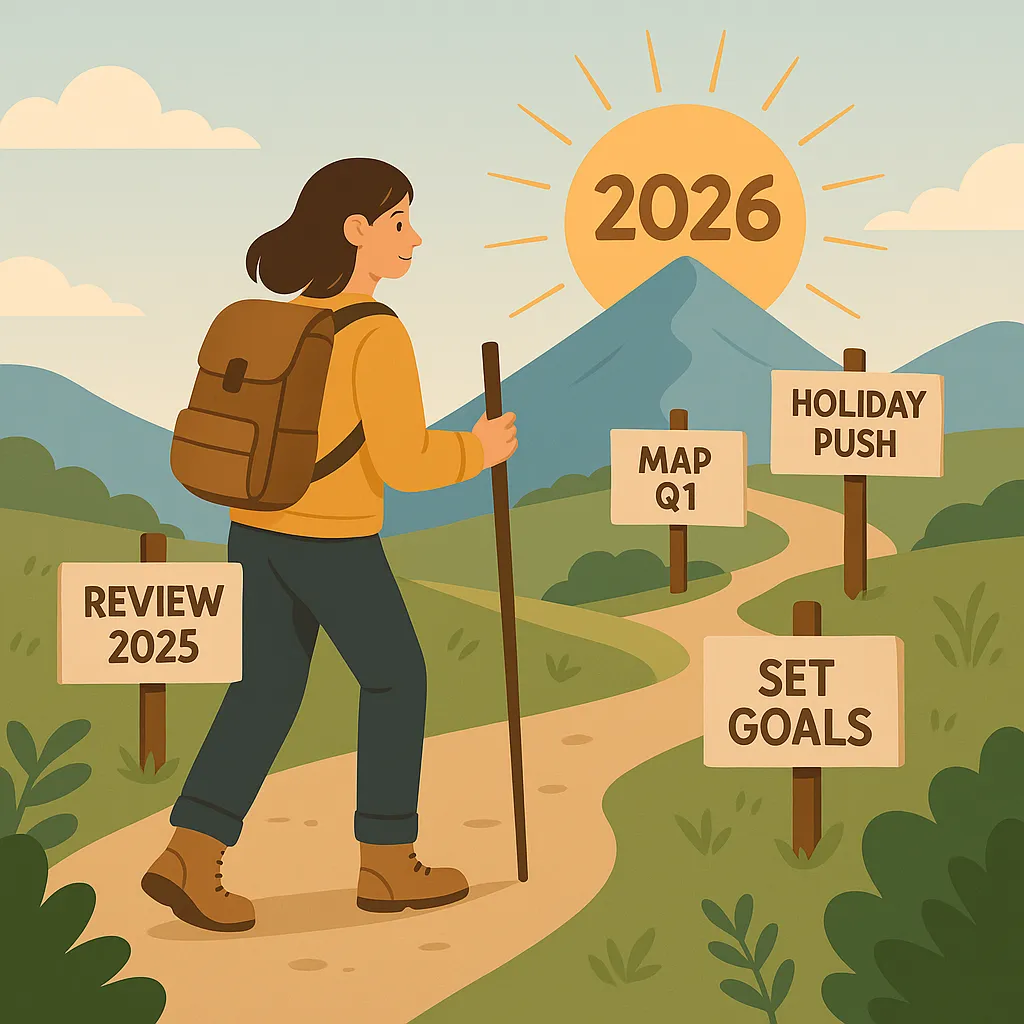


We’re knee-deep in the 2025 holiday madness—inventory lists a mile long, too many late nights, and customers squeezing in just one more rush order. But here’s the move nobody talks about: now is the smart time to jumpstart your 2026 game plan. Don’t wait for January’s so-called “fresh start.” You want real momentum next year? You start building it before the calendar flips. Most business owners will coast through the rest of December and scramble in the new year. Let’s not be those people.
A clear marketing strategy sets the tone for everything you do this year. Forget “wait and see” or flying by instinct alone. If you want real progress, you need an actionable plan.
A new year isn't just a calendar flip; it's a clean slate. It's your shot to drop the time-wasters and go all-in on what actually gets results. With more than 20 years in the tech world, I’ve seen how goal-setting and strategy play out in big, complicated corporate environments—the endless meetings, the massive decks, the jargon. But behind all that noise, there’s something that actually works, and you don’t need to wade through the corporate red tape to put it to work for you.
What really matters is a simple, proven, no-nonsense approach to mapping your marketing for the next 12 months. Not a 50-page “strategy document” nobody reads—just a clear, actionable plan that helps you stop putting out fires and start making real moves. This is how you shift from reacting to everything that gets thrown at you, to finally taking the driver’s seat.
Look Back Before You Leap Forward
Before you can figure out where you’re going, you need an honest look at where you’ve been. Too many business owners skip this step because it feels like a waste of time, or worse, they’re afraid of what they’ll find. Check your ego at the door and dig into the data from last year.
Start with the basics:
- What actually made you money? Go beyond gut feelings. Look at your sales data. Was it a specific product, a service, or a seasonal promotion that carried the weight? If you ran a "20% off" sale that brought in a flood of low-margin customers who never came back, was it really a win?
- Where did your best customers come from? Was it foot traffic from a local farmers market in Novato? A Facebook ad you ran targeting Petaluma? Or referrals from a handful of loyal regulars? Knowing this tells you where to point your megaphone in 2026.
- What was a total flop? Be brutally honest. Did you spend a grand on print ads in a local paper that resulted in zero calls? Did you pour hours into a TikTok account that only your niece follows? Acknowledge the failures. It’s not about blame; it’s about not making the same expensive mistakes twice.
Gathering this information isn’t just an accounting exercise. It’s the foundation for every marketing decision you’ll make this year.
Identify Your Real Opportunities
Now that you know what worked and what didn't, you can start spotting opportunities. This isn’t about chasing every shiny new marketing trend. It's about finding the strategic gaps you can realistically fill. For a small business in the North Bay, your opportunities are likely closer to home than you think.
Consider these areas:
- Local SEO: When someone in Santa Rosa searches for "best coffee near me," does your shop show up? If not, you're invisible to a massive chunk of potential customers. Optimizing your Google Business Profile is not optional anymore. It’s the modern-day Yellow Pages, and getting it right is one of the highest-impact things you can do for your business.
- Community Engagement: Are you just a business in the community, or are you part of it? Sponsoring a Little League team, hosting a mixer for other local business owners, or partnering with a non-competing business for a joint promotion are all ways to build real-world connections that translate into loyal customers. People in our area want to support local businesses they know and trust.
- Existing Customer Base: You probably have a list of past customer emails or phone numbers collecting digital dust. These people have already given you their money once. They are far more likely to do it again than a complete stranger. What are you doing to stay in front of them? A simple monthly email newsletter with updates or a special offer can work wonders.
Pick one or two key opportunities. Trying to do everything at once is a surefire way to accomplish nothing.
Set Goals That Aren’t Just Wishes
"I want to grow my business" is not a goal. It's a wish. To make real progress, you need to set goals that are specific, measurable, achievable, relevant, and time-bound (SMART). It sounds like corporate nonsense, but it works.
Here’s how to translate vague wishes into actionable goals:
- Instead of: "I want more website traffic."
- Try: "Increase organic website traffic from local search by 20% by the end of Q2 by publishing one new blog post per month and getting five new local backlinks."
- Instead of: "I want to be better at social media."
- Try: "Grow my Instagram following by 500 local followers in 2026 by posting three times a week and running one giveaway with another North Bay business each quarter."
- Instead of: "I need more sales."
- Try: "Increase online sales by 15% over the next six months by launching a targeted email campaign to our existing customer list."
See the difference? A real goal gives you a target and a deadline. It tells you exactly what you need to do, turning a vague hope into a concrete plan of attack.
Create Your Roadmap
You have your goals. Now, how will you get there? A roadmap breaks down your year-long ambition into quarterly, monthly, and even weekly tasks. This is where the strategy becomes reality.
Grab a calendar and start plugging things in.
- Q1 (Jan-Mar): Focus on foundational work. If your goal is better local SEO, Q1 is for revamping your Google Business Profile, doing keyword research, and planning your first few blog posts. If it's email marketing, this is when you clean up your list and choose an email provider.
- Q2 (Apr-Jun): Build momentum. Launch that email newsletter. Start posting consistently on social media. Reach out to that other local business about a partnership.
- Q3 (Jul-Sep): Analyze and adjust. Look at your progress. Is the blog driving traffic? Are people opening your emails? Use the data to tweak your approach for the second half of the year. Maybe Reels are working better than static posts, so you decide to focus more on video.
- Q4 (Oct-Dec): Capitalize on your efforts. This is go-time. Your holiday marketing campaigns will be built on the foundation you've been laying all year. You'll have an engaged audience and a clear message, ready for the busiest season.
A roadmap prevents that "what should I be doing today?" paralysis. It gives you a clear set of tasks so you can focus on execution instead of constantly second-guessing your strategy.
Stop Thinking and Start Doing
Planning is essential, but a plan gathering dust on a shelf is useless. The goal of this process isn't to create a perfect document; it's to build a framework for consistent, focused action. It’s about making smarter decisions that move your business forward, one week at a time.
This can feel overwhelming, especially when you're also managing inventory, employees, and everything else that comes with running a business. If you’ve read this far and feel like you don’t have the time or the know-how to do it yourself, that’s okay. That’s what we’re here for. We help local business owners like you create and execute marketing plans that get results.
Whether you tackle it yourself or decide you need a hand, the important thing is to start now. Don't let 2026 be another year of just getting by. Make it the year you take control.